On the Road to Social Impact

IMG_4556.JPG

By Genevieve Hunt

As damp, gray clouds blanketed mile upon mile of Massachusetts’s farmland, I drove CIRCLE UP film subjects Janet Connors and Clarissa Turner to meet our filmmaker Julie Mallozzi for two screenings in Brooklyn and Manhattan. We had scheduled two events in one day: the first a restorative justice professional development for the NYC Department of Education and the second a screening at New York Law School for what would be an audience of over 200.  The long hours in the car –  stuck in traffic on the Brooklyn Bridge and praying our GPS would not lead us astray – were a wonderful opportunity for me to spend with Janet and Clarissa. Janet kept my boredom at bay with stories of growing up Irish-American in Dorchester. From the back seat, Clarissa plied us with enough snacks to feed her six children back home in Boston.

I had been looking forward to this trip because it is always a wonderful experience to watch our film with an audience and get their feedback in a face-to-face setting. As an impact coordinator for CIRCLE UP, my job is to find the audiences who want to change our society’s way of thinking about harm and punishment and will use our film as a tool to drive that impact.  I write hundreds of emails inviting teachers, school administrators, faith leaders, college professors, probation officers, lawyers and judges because they have the ability to impact how justice is served in their communities.  I set up trip logistics and drive our film subjects to screenings where they lead circles and panel discussions.  I make sure the connections work for Skype conversations and the visual and audio equipment is ready. All the work is worth it because I’ve seen the power of CIRCLE UP move audiences from distraught teens to judges with decades of experience in a stressed and unforgiving criminal justice system.. I learn so much about how the film could be used by various audiences, educational institutions and social justice organizations to spread the work of restorative justice in the US.  People come up to me with tears in their eyes pushing scraps of paper at me with names of contacts they insist need to see the film. They tell me about a time when they forgave someone for something unthinkable or when they themselves were forgiven for a transgression they’ve committed and how it changed their life. 

No matter how many times I see CIRCLE UP, I learn something new. I watch the faces of Janet and Clarissa and think about how courageous and loving they are to share something so painful over and over again so that others can learn that forgiveness is possible. During this trip, it was wonderful to hear one educator in a restorative circle share how much staff and teachers needed to hold support circles for each other so that they could adopt a restorative mindset in the classroom. Later that day, I felt tears prick the back of my eyes as I watched a group of law students gather excitedly around Janet as if she were a rock star. “Mama J” gathered the group in her arms for warm hugs and photos. I listened to Clarissa gently explain to the astonishment of several law school professors how her faith in God lifted her up and prompted her suddenly to blurt out to her son’s killer in court that she forgave him. As always, seeing these two extraordinary women share their experiences with others has an uplifting effect on me.  

In the weeks following our trip to NYC, more high schools, churches and law schools are contacting us, wanting to share CIRCLE UP as an example of what restorative justice truly looks and feels like with their educators and students as they begin building or refining their own restorative justice programs. I look forward to getting out on the road again across America to meet people who gather in schools, courtrooms, prisons, churches, and colleges, hoping to hear about an alternative path to justice based on restoring wholeness to individuals and communities.

Advancing Restorative Justice in NYC Schools

CIRCLE UP NYC Department of Education.jpg

The CIRCLE UP team just returned from an exhilarating trip to New York City to lead a professional development event for principals, restorative justice coordinators, and social workers from 19 of the city’s public schools.  Our goal was to help this dedicated cohort of educators reflect on the successes and challenges of implementing restorative justice – and to showcase our film as a tool for demonstrating what RJ looks and feels like.

After a casual welcome breakfast, filmmaker Julie Mallozzi, film subjects Janet Connors and Clarissa Turner, and impact coordinator Genevieve Hunt presented the film to the 50 participants and held a panel discussion about what brought them to do RJ work in schools – and what they have learned in the process.  We then broke into several smaller circles, each co-facilitated by a local educator and a member of the CIRCLE UP team, to explore participants’ responses to the film and to reflect on what might be needed to further RJ at their schools.  Returning to the full group, we shared what we learned and brainstormed how CIRCLE UP might be used with staff, students, and families to model restorative practices.

Each school received a copy of the CIRCLE UP DVD, which includes both the 69-minute feature and the 14-minute short, and a print copy of our fresh-off-the-press Facilitator Guide. 

The gathering concluded with a vociferous request for Janet and Clarissa to go on a “speaking tour” to individual schools in New York City.  Their powerful testimony, as mothers who lost sons to homicide and now help other children break cycles of revenge and violence, always sets a room afire.

A Second Festival Circuit

CIRCLE UP Globe Docs Film Festival

After making the rounds of film festivals with the CIRCLE UP feature – screening in dozens of cities across the country – we are now starting a second round with our new short version of the film.

At 14 minutes, the short conveys the heart of the story of Janet Connors’ and Clarissa Turner’s transformation of trauma into healing.  We created it to make it possible for the film to be included in shorter class periods for students or trainings for professionals.  And a side benefit is that it opens up interesting programming opportunities for festivals, too!

Bringing Emotional Narrative to a Courthouse

CIRCLE+UP+Social+Law+Library+screening

by Genevieve Hunt

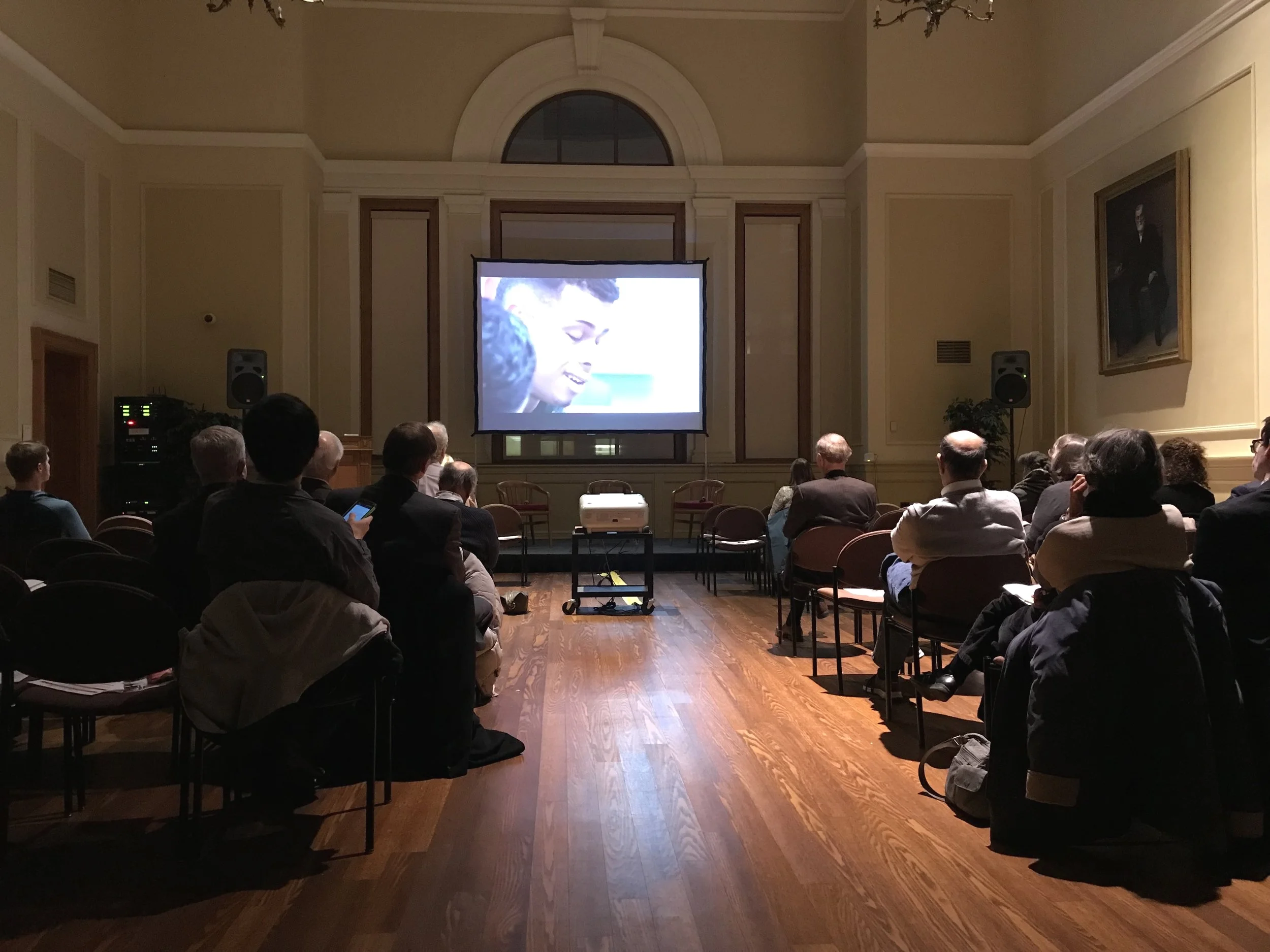
Last night filmmaker Julie Mallozzi, our film subjects Janet Connors and Clarissa Turner, and I presented a screening discussion of CIRCLE UP at the Social Law Library in Boston’s John Adams Courthouse before an audience of judges, lawyers and other court professionals. As we walked through the hushed library past classical wood friezes and shelves filled with heavy, leather-bound law books, I remembered a scene in CIRCLE UP where Janet remarks that she felt her son’s life didn’t matter at all in the courtroom – that the that the whole trial process seemed to her driven by the prosecutor, the state, and the defendant. Would this audience of judges and lawyers be more sympathetic to the victim families tonight?

My worries were unfounded as the audience was hushed and attentive, passing tissues as Janet recounted the details of her son’s murder and Clarissa tearfully remembered the moment she spontaneously forgave her son’s murderers in court. During the panel discussion, Janet and Clarissa held the audience spellbound as they shared their journey through grief and anger to forgiveness and healing after the brutal murders of their sons. They spoke movingly about the transformative power of forgiveness and the desire to help create a positive way for harm-doers to show accountability and return to their community. Janet and Clarissa stressed that their desire to spare other families from the pain of losing a child motivated them to continue sharing their story and helping young people find ways to turn away from revenge violence. 

Audience members were deeply appreciative of Janet and Clarissa’s sharing of their emotional journey and asked questions about the restorative justice experience. One audience member thoughtfully asked if there was any communication with the families of harm-doers; both Janet and Clarissa spoke about the sorrow and pain shared by victim and defendant families. The panel discussion ended on a positive note when a psychiatrist from McLean Hospitalsaid he would like to share the film with his patients because"Forgiveness can't be prescribed but it's a wonderful medicine."

 As we left the screening, I reflected on how much more powerfully film conveys the emotional impact of a court trial than a court transcript or a newspaper story. It offers court professionals a way to think about the consequences of traditional justice processes and begin to consider how bringing victims and harm-doers face-to-face in a restorative justice setting may serve both sides more effectively. 

 We have had a lot of interest from the legal community in CIRCLE UP. As more states and municipalities grapple with criminal justice reform and ways to reduce the prison population, we’ve gotten more requests for screenings from state legislators and law schools around the country (including Harvard, Drexel and New York Law School). We hope to do more these kinds of screenings and discussions about the role that forgiveness and personal accountability can play in reducing recidivism and increasing healing among crime victims and their communities.

Thank you to Social Law Library Executive Director Robert Brink for bringing this emotional narrative inside a courthouse!